Tuesday, May 5, 2020

Fred Ritchie

Fred Ritchie's “Digital photographs, frequently made while peering at the cameras back, concretize the central paradigm of the screen. Veteran press photographers, for example, refer to the digital colleagues as “chimping” (said to be derived from the actions of the chimpanzee), given that they can frequently be seen looking down at the screen and pressing a lot of buttons even in the middle of an of it.” 
This comment is one of his that really stood out to me, it is so true. To this day people really are like chimps. We are so addicted to our cell phones or laptops, iPads, other smart devices that we see photography all the time. But they don't even realize it because they are just "chipping" away at the screen.

Another one of his quotes I liked was "The
 idea 
of
 a
 portrait 
will 
evolve 
to 
depict
 what 
may 
be
 a 
virtual
 being,
 not
 an 
actual
 one,
 taking 
into 
account 
our 
alter 
egos
 as
 avatars.” 

This comment is also very true. When we do self portraits or portraits in general, one can either be themselves or not. But what is more interesting? An alter ego of a person can really come out in portraits because they can act like they are somebody they are not. This can be very beneficial or not. It all depends on what wee see and what we can depict. 

My final quote that caught my attention from Ritchie is "The contradictory "double image" is cubist; reality has no single truth." 

I like this quote because of how true it is. Photography is really all about perspective. This can either be a really good or bad thing. With this comes altering or unaltered realities that can be tricky to deceiving. A double image is one that has two meanings. One is the image of meaning, the other is the image of staging. Within these two comes an idea of what is the truth and what is not. Ritchie explains that there is truth between these two images or ideas, somewhere between the grey areas.This is very true when it comes to photography. 

David Maisel

David Maisel was born in New York in 1961. He started out his career by doing photography and video. Maisel's work was really focused on the production of space that was within his photographs. He also focused on landscapes and objects within them that were sometimes hidden in by the view of which is was being seen. His most known photographs were almost all in aerial view, this is when the view is from above and out. Things get fainter in the distance, almost like atmospheric perspective as well.
One of his most known photographs is one of my favorites.
I particularly like this one because I try to figure out what it really is. Is It water? Is it dry ground? I don't know. I also love how this is reed, it makes one question and visualize the image even more. When I look at this image deeper, I think that it is water that Maisel converted to a red color to give it a more mysterious idea behind it.
I also love how clear this photo is, that is why I also believe that it is water. At the very top in the center, there is almost a glare in the middle. I also question what that is when I look at it because it is much different than what is surrounded by it. This photo of aerial view of (I think an ocean) is a beautiful and mysterious render, that is why I love this image so much.


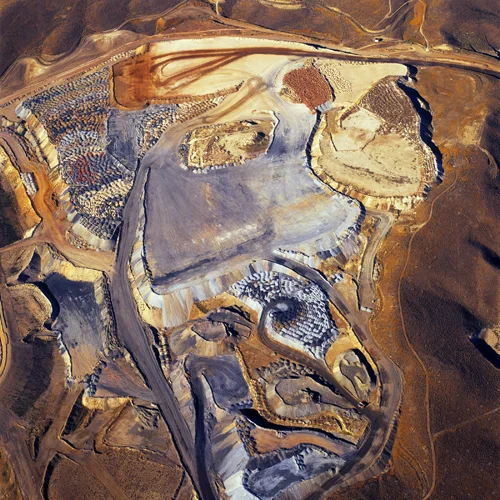
Another one of his images that I enjoy looking at is this one.
I love this one because it reminds me of marble. But when I look closer to it, I believe it is an aerial view of maybe what was an old coal ground or mining grounds. Maybe even someplace where they get oil from. I am not sure, but what I am sure of is that Maisel never fails to make the viewer question what he is taking a photo of, and make sure you are looking into the deeper parts of the photo. His work reminds me of some other photographers we have talked about that took aerial views of things, but his work is very different in many ways.
Maisel is an aerial photographer from New York who specializes in this and I really appreciate his work.

Abelardo Morell

  Abelardo Morell was born in Havana, Cuba in 1948. He immigrated to the United States with his parents in 1962. He attended the college of ...